
Will Fixing Exterior Drainage Keep Basement Water From Coming Back?
The Short Answer: Exterior Drainage Stops Surface Water, Not Always Groundwater
Fixing exterior drainage can stop basement water from returning when the water starts at the surface. That includes roof runoff, downspouts emptying beside the house, soil that slopes toward the walls, and low spots that hold rain against the foundation. Exterior work cannot remove water that is already moving through the soil around and under the basement. If water keeps coming back after the outside problems are corrected, the source is usually below grade, and an interior drain with a sump pump is usually part of the answer.
The difference comes down to where the water is when it reaches your foundation. Surface water comes off the roof and across the yard, and you can usually watch where it goes during a storm. Groundwater is rain that has already soaked into the soil. When the soil around a basement becomes saturated, that water pushes against the walls and up under the floor slab. That push is called hydrostatic pressure, and it can drive water through cracks, through the cove joint (the seam where the wall and floor meet) and through the concrete itself.
Exterior corrections are often the right first step, and for some homes they are the only step needed. They are usually the least disruptive work, and they reduce the water reaching the foundation no matter what else the house needs. Many homes around St. Louis are older, and clay soils that hold water and swell as they get wet are common in parts of the region. In homes like these, when the water shows up and where it comes in are often better clues than how much water there is. If you are still sorting out possible causes, our article on why water comes into a basement after heavy rain walks through them. This guide covers the next decision: whether outside work alone will be enough.
First, Make Sure It Is Really Seepage
Before paying for drainage work, rule out water that has nothing to do with the yard. Several look-alikes show up in basements, and neither grading nor an interior drain will fix them.
- In humid weather, moisture in the air can bead up on cool walls, floors and pipes. Our guide on telling seepage apart from condensation explains how to check.
- A floor drain backing up. Water rising out of a floor drain may point to a blocked drain line or a sewer backup rather than groundwater. That is a job for a plumber, so start there.
- Plumbing and appliance leaks. Supply lines, water heaters, washing machines and water softeners can all leak. Water that appears on dry days or sits near an appliance usually points here.
- Moisture without puddles. A musty smell, damp air or white chalky deposits on the walls can mean water is getting in even when you never see standing water. Those deposits are called efflorescence, the mineral residue left when water moves through concrete and evaporates. Read more about what a musty basement smell can mean.
What Exterior Drainage Can Realistically Fix
Most exterior drainage problems deliver extra water to one part of the foundation. Clogged or undersized gutters overflow and drop roof water right at the wall. Downspouts that discharge next to the house concentrate the water from a whole section of roof in one spot. Extensions and buried downspout lines carry that water away, but buried lines can clog or get crushed and quietly back up near the foundation.
The ground matters just as much. Soil should slope away from the house so water runs off instead of soaking in along the wall. Backfill, the soil placed against the foundation after the basement was built, often settles over time and leaves a shallow trench that collects rain. Low spots, swales that send water toward the house instead of around it, and window wells that fill during storms all put water where you do not want it. Patios, driveways and walks that pitch toward the house, or a neighbor’s yard that drains onto yours, can do the same.
These problems produce a recognizable pattern indoors. Water shows up during a rain or shortly after, and it tends to appear near one corner, one wall or below one downspout. When the wet spot inside lines up with a clear problem outside, exterior work has its best chance of solving it. Depending on the yard, that might mean gutter repairs, downspout extensions or buried lines, regrading, or yard drains and catch basins that collect water and carry it off. The goal stays the same: move water away from the house and keep the ground sloping away so it cannot run back.
If regrading involves a landscape retaining wall, check permit rules first. As one local example, a Webster Groves draft ordinance, Bill 9098, would exempt retaining walls not over three feet tall, measured from the bottom of the footing to the top of the wall, from permits unless the wall supports a surcharge. The same draft says an exemption does not authorize work that violates the code. That draft applies to one city only; the City of St. Louis and other St. Louis County municipalities set their own rules, so call your local building department. You can see how we handle outside water problems on our yard drainage solutions page.
A Rainy-Day Yard Walk Checklist
The best way to find surface water problems is to go outside while it is raining or right after a steady rain stops.
Bring a phone for photos and something to take notes on, then walk the full perimeter of the house.
Are the gutters overflowing anywhere, especially at corners and inside angles of the roof?
Where does each downspout empty, and does that water flow back toward the house?
Is water standing against the foundation, in planting beds or in window wells?
Does soil, mulch or a planting bed slope toward the wall instead of away from it?
Has backfill settled into a trench or dip along the foundation?
Does a patio, driveway, walkway or neighbor’s yard send water toward the house?
Back inside, which wall or corner is wet, and how long after the rain started did the water appear?
Take photos of both the outside problem and the inside wet spot.
Matching them up is the point of the exercise, because it shows whether the water inside follows what you saw in the yard.
If you later schedule an inspection with us or anyone else, those notes and photos lead to a faster, better diagnosis.

Signs Exterior Fixes Alone Probably Will Not Be Enough
Some patterns point to water that is already in the soil, where surface corrections have little to work on. Watch for these:
- Water returns after solid exterior fixes, or appears a day or more after rain or during long wet stretches without a heavy storm.
- Water enters at the cove joint around much of the basement. Our article on water coming in where the wall meets the floor covers that seam in detail.
- Water comes up through cracks in the floor rather than running down a wall.
- Seepage shows up on several walls instead of one corner.
Homeowners often ask how long to wait after exterior work before deciding it did not work. No single waiting period fits every house. Give the corrections a fair test through several hard rains and at least one long stretch of steady rain, because saturated soil builds pressure more slowly than a single storm does. If water returns at the same spots after that, the exterior work likely handled only part of the problem.
In homes where exterior drainage has been properly installed, we rarely see the water come back. The exceptions we run into tend to be homes with yards graded toward the foundation or houses at the bottom of a hill, where more water reaches the soil around the basement than surface fixes can manage. Those homes may need more substantial waterproofing. Sealing a crack by itself rarely solves pressure-driven seepage either, because the water tends to find the next weak point; our article on whether sealing cracks stops basement water explains when sealing helps.
Structural warning signs: Horizontal cracks, stair-step cracks in block walls with inward movement, and walls that bow inward are structural signs, not just water signs. They need a wall evaluation before any decision about drainage or waterproofing. See our bowed wall repair page for what that evaluation involves.
How Interior Drains and a Sump Pump Fit In
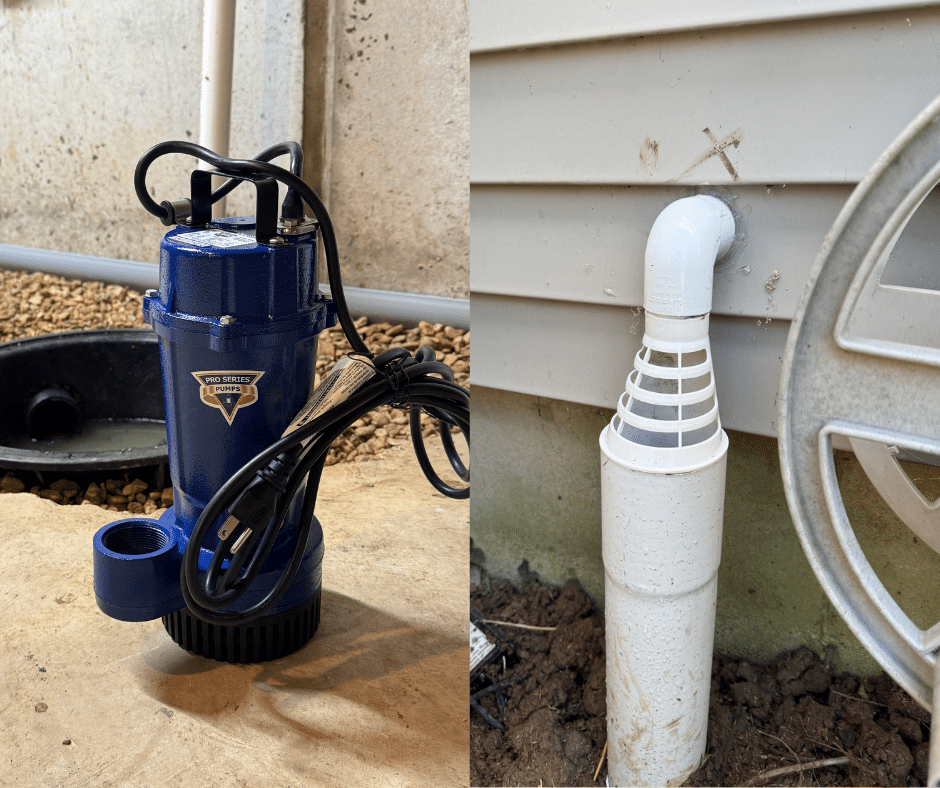
An interior perimeter drain, often called an interior French drain or drain tile, runs along the inside edge of the basement floor at the base of the walls. It collects water that reaches the foundation and carries it to a sump basin, a pit set into the floor. A sump pump in that basin pushes the water out of the house before it can spread across the floor. Because the drain gives water an easy path at the base of the wall, it also relieves the pressure that forces water through the cove joint and floor.
Are French drains effective in basements? When water is coming from the soil, an interior drain and sump are one of the most dependable ways to keep the floor dry, and in those cases we generally prefer an interior system because it holds up better over the long term. It still helps to know what these systems do not do. They do not stop the soil outside from becoming saturated; they manage the water once it arrives. They depend on a working pump and electricity, so the pump needs periodic checks and a plan for power outages. They also do not repair foundation movement, which is a separate structural question.
The downsides of an interior French drain are mostly about installation and upkeep. Installing one usually means opening the floor along the walls, which is more disruptive in a finished basement where flooring and lower wall finishes near the perimeter may need to come out. The pump discharge also has to end somewhere away from the house, or the water can cycle back into the soil you are trying to drain.
That is why exterior and interior work are so often combined. Water kept away from the foundation by gutters, downspout lines and grading is water the interior system never has to handle, so the pump runs less. Costs vary with the length of the basement perimeter, whether the space is finished, how much floor has to be removed, where the discharge line runs and which pump is used. Our sump pump installation page explains the pump side of the system.
How to Decide: Exterior, Interior or Both
Start with exterior work when your yard walk shows clear surface problems and the water appears only during or right after rain near those spots. Plan on an interior drain and sump, usually alongside exterior corrections, when water returns after the exterior fixes, appears long after rain, or comes in at the cove joint or through the floor. Get a structural evaluation first when walls show horizontal cracks, stair-step cracks with movement or bowing, because the wall question changes everything that follows.
Our own crews handle both sides of that decision. We install interior drainage systems, sump pump systems, Durawall panels and underground downspout extensions, along with exterior waterproofing where it is needed. Because we do both kinds of work, we can recommend the path that matches where the water is actually coming from.
If you are wondering whether insurance will help, coverage for basement seepage depends on your policy and on what caused the water. Ask your insurer directly, ideally before any work begins.
If water came back after rain, or after gutters, downspouts or grading were already fixed, do the rainy-day yard walk first. Then schedule an inspection so we can find where the water is getting in before you choose exterior work, an interior system or both, and bring your notes and photos to the visit. You can request an inspection through our basement waterproofing in St. Louis page.