
How Do We Tell Whether Water Is Contributing to Foundation Movement?
Water and foundation movement are often connected, but not every foundation problem is caused by poor drainage. A crack can come from settlement, soil movement, wall pressure, previous construction, or conditions that developed years ago. That is why we do not look at a wet yard or a foundation crack and automatically assume one caused the other.
When we inspect homes around St. Louis, we look at how water is moving around the property, how the soil is reacting, and whether the pattern lines up with what we are seeing in the foundation. The goal is to determine whether water is simply present or whether it is actually contributing to the movement.
Why Water Matters Around a Foundation
The soil around a foundation changes as moisture levels rise and fall. This is especially important around St. Louis because clay-rich soils tend to hold water and drain more slowly than sandy soils. Missouri Extension notes that clay soils have very small particles that can slow water movement and increase surface runoff.
During prolonged wet weather, the soil around a home can become saturated. That can increase pressure against basement walls and change the way the soil supports the foundation. During hot, dry periods, clay-rich soils can shrink and pull away from portions of the foundation. Those repeated changes in moisture can contribute to movement over time.
This is one reason we are interested in drainage during a foundation inspection. We want to know whether one area of the home is being exposed to very different moisture conditions than the rest.
We Start by Looking at Where the Movement Is Happening
The location of the foundation problem gives us one of our first clues.
If settlement is concentrated at one corner of the home and we also find a downspout dumping water beside that corner, poor grading, or an area that stays saturated after rain, the drainage deserves a closer look. If the movement is happening somewhere with good drainage and no obvious water concentration, we may need to look harder at soil support, fill conditions, construction history, or another cause.
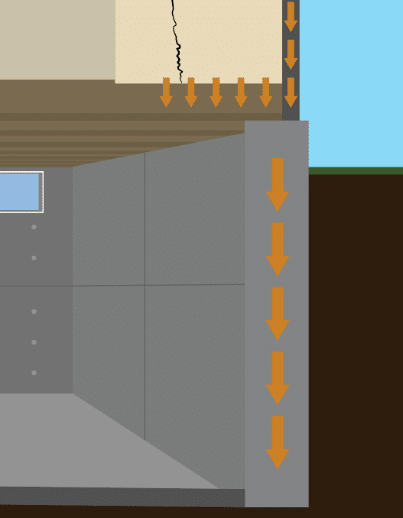
The same applies to basement walls. A wall that is bowing inward may be dealing with pressure from the soil outside. If that same side of the house has poor drainage or regularly saturated soil, moisture may be increasing the load the wall has to resist.
We are looking for a connection between where the water goes and where the structure is moving.
Gutters and Downspouts Tell Us a Lot
Roof runoff can put a surprising amount of water into one small area around a foundation. During an inspection, we look at where the gutters discharge and whether the downspouts are moving water far enough away from the house. A short extension, missing extension, clogged underground line, or downspout that empties directly beside the foundation can keep one section of soil much wetter than another.
We also look for signs that water has been concentrating there for some time. Erosion, washed-out mulch, low areas beside the foundation, staining, or constantly damp soil can all help us understand the history of that part of the property.
A downspout by itself does not prove that it caused foundation movement. But if the drainage problem lines up with settlement or wall movement in the same area, it becomes part of the diagnosis.
We Check the Grade Around the House
The ground around a home should generally encourage surface water to move away from the foundation rather than toward it. When the yard slopes toward the house, water can collect along the foundation after rain. The same thing can happen when landscaping settles, soil erodes, or patios and sidewalks direct runoff toward the structure.
We pay particular attention to low areas where water can sit for long periods. The longer the soil remains saturated, the more likely it is to behave differently from the soil around the rest of the house.
Sometimes the drainage problem is obvious. Other times the yard looks relatively flat until we follow the low points and see how runoff reaches one particular side or corner of the foundation.
We Look at What Happens After the Rain Stops
Timing can tell us a lot. Some homeowners notice that foundation or basement problems become more obvious during a major storm. Others tell us that the yard remains saturated for days afterward or that basement seepage does not begin until hours after the rain stops.
That delayed response can point toward water moving slowly through the soil rather than simply running across the surface. Clay-heavy soils can hold moisture for long periods, and water can continue moving through backfilled soil around a foundation after the storm has passed. Perma Jack has documented this type of groundwater behavior on St. Louis-area properties where saturated soil contributed to pressure beneath or around the foundation.
When we hear that the problem follows a consistent weather pattern, that information becomes useful.
Bowing Walls and Settling Foundations React to Water Differently
Not all foundation movement involves the same forces. A settling foundation is usually moving vertically because the soil below part of the footing is no longer providing the same support. Water can contribute through erosion, poorly compacted fill, saturation, or repeated changes in clay soil moisture.
A bowing basement wall is different. The wall is being pushed inward by lateral pressure from the soil outside. When that soil becomes heavily saturated, the pressure against the wall can increase. On older block foundations, that may show up as horizontal cracking, inward bowing, or movement along mortar joints. Understanding the direction of movement helps us determine how water may be involved.
Cracks Help Us Understand the Pattern
We do not diagnose drainage from a crack alone, but crack patterns can support what we see elsewhere. For settlement, we may see stair-step cracking in brick or block, diagonal cracks around doors and windows, or separation concentrated near one portion of the home. For wall pressure, we may see horizontal cracking or inward movement through a basement wall.
We compare those patterns with the drainage around the property. If the most significant movement is concentrated on the same side where the soil stays wet, the gutters overflow, or the grade directs water toward the house, that relationship matters. If the crack pattern does not line up with the drainage conditions, we keep looking.
Floor Elevations Can Help Confirm Settlement
Sometimes the clearest evidence is not the crack. It is the way the floor elevations change across the house. If one corner of the foundation has moved downward, the floors above that area may also be lower. By looking at the elevation pattern, we can get a better idea of whether the movement is isolated or spread across a larger part of the structure.
We then compare that information with what we find outside. If the low portion of the structure lines up with an area of poor drainage or chronic soil saturation, water may be one of the contributing factors.
This is also why we do not assume every sloping floor is caused by drainage. Older homes can have long-standing elevation differences, framing changes, or previous settlement that is no longer active.
We Ask About the History of the Property
The homeowner often knows things we cannot see during a single inspection.
We may ask:
- Does water collect here after every heavy rain?
- Has a downspout always discharged in this area?
- Was the yard regraded or landscaped recently?
- Did the cracking appear after an unusually wet or dry season?
- Has the foundation problem changed over time?
- Have there been previous waterproofing or drainage repairs?
- Do cracks seem to open and close with the seasons?
Those details help us put the current condition into context.
Foundation problems usually develop over time. Knowing what the property has been doing over the last several years can be just as important as what we see on the day of the inspection.
Sometimes Dry Weather Is Just as Important
Water contributing to foundation movement does not always mean there is too much water. St. Louis clay soils can also shrink during extended dry weather. As the soil loses moisture, it can contract and pull away from the foundation. If part of the footing loses support while another part remains stable, differential settlement can occur.
That is why we pay attention to both extremes. A home may have drainage problems during wet months and significant soil shrinkage during a dry Missouri summer. The larger issue may be the repeated moisture change rather than one isolated storm.
Does Fixing the Drainage Stop the Foundation Movement?
Sometimes drainage improvements are an important part of the solution, but they do not automatically reverse structural movement that has already occurred.
If poor drainage is contributing to saturated soil, erosion, or excess pressure around the foundation, correcting the water problem can help reduce one of the forces acting on the structure. That may involve gutters, downspouts, grading, yard drainage, or another way of moving water away from the home.
But if a foundation has already settled significantly or a basement wall has bowed, drainage work alone may not be enough. The structure may still need stabilization or repair.
We separate those two questions:
What is contributing to the movement?
and
What does the structure need now that movement has occurred?
Sometimes the answer includes both drainage and structural repair.
We Do Not Recommend Drainage Work Just Because the Ground Is Wet
This is an important part of how we approach foundation problems.
Almost every home has wet soil around it at some point. Seeing moisture does not mean we immediately recommend a drainage system. We want evidence that the water conditions are actually affecting the foundation or creating another problem around the home.
We look at the movement pattern, crack history, floor elevations, soil conditions, grading, downspouts, basement water, and what the homeowner has observed over time. If those pieces fit together, drainage may become part of the repair plan.
If they do not, we keep looking for the real cause.
Does Active Movement Mean I Automatically Need Foundation Piers?
When water may be contributing to foundation movement, we look at the property as a complete system rather than treating the foundation and drainage as unrelated problems.
| What We Check | What It Helps Us Understand |
|---|---|
| Crack patterns | How and where the structure has moved |
| Floor elevations | Whether settlement is concentrated in one area |
| Bowed or leaning walls | Whether lateral soil pressure may be involved |
| Gutters and downspouts | Where roof runoff is being discharged |
| Yard grading | Whether surface water moves toward the foundation |
| Standing water | Where soil may remain saturated |
| Soil conditions | How moisture may be affecting support or pressure |
| Basement seepage | Whether groundwater is building around the foundation |
| Previous repairs | What problems have existed in the past |
| Homeowner observations | Whether movement changes with weather or over time |
None of these items gives us the answer by itself. The value comes from seeing how they relate to one another.
The Goal Is to Find the Cause Before Choosing the Repair
Water can absolutely contribute to foundation settlement and basement wall movement, especially in a region with moisture-sensitive soils and large seasonal changes like St. Louis. But it is only one possible part of the problem.
At Perma Jack of St. Louis, we want to understand why the foundation is moving before we decide what should be repaired. Sometimes that means structural stabilization. Sometimes drainage needs to be addressed as part of the project. In other cases, the water around the home may not be the main cause at all.
If you have foundation cracks, uneven floors, a bowing basement wall, or movement that seems to change after wet or dry weather, contact our team for an inspection. We can look at the foundation, the drainage around the property, and the history of the movement to determine whether water is contributing and what the home actually needs.