
Why Are My Driveway Expansion Joints Closing Up?
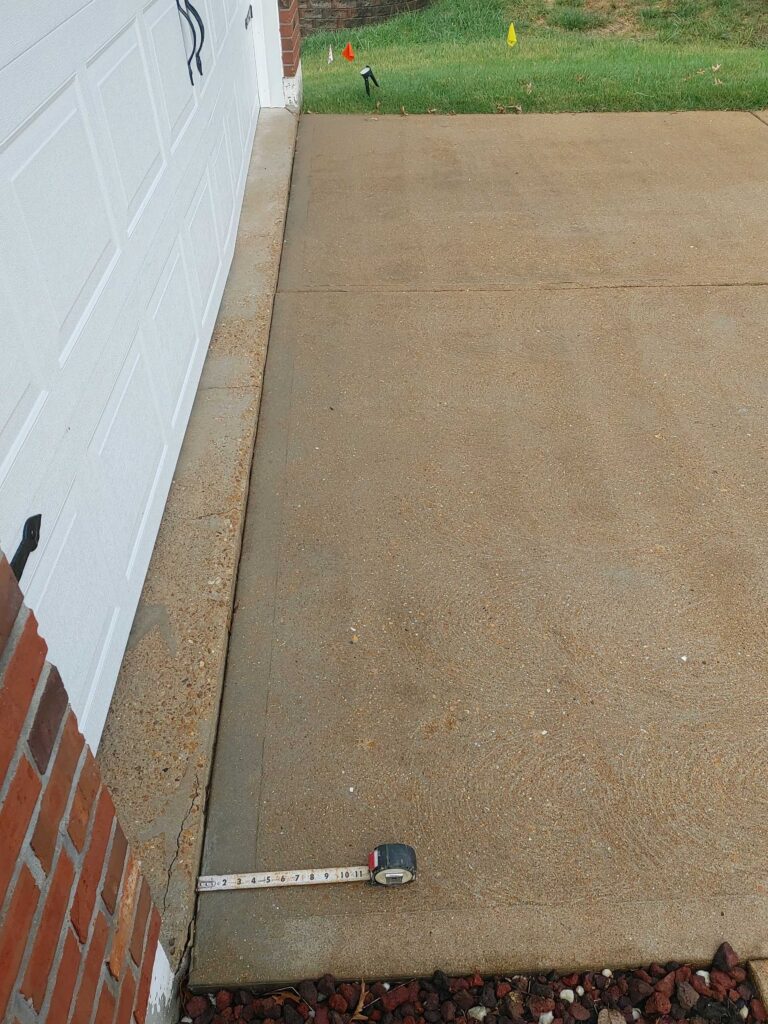
A driveway expansion joint that looks like it is closing does not automatically mean you have a structural problem. Dirt may be packed into the gap, old filler may have compressed, or seasonal concrete movement may temporarily make the joint look tighter.
We become more interested when the same joint stays closed year-round, continues getting tighter over several years, or appears alongside chipped concrete, shifting slabs, or new cracking near the garage. In those situations, the joint may no longer be providing enough space for the concrete to move.
That can matter around St. Louis because a series of compressed joints can allow pressure to travel through the driveway toward the garage. Before calling it street creep, though, we want to separate normal joint maintenance from actual pavement movement.
What a Driveway Expansion Joint Is Supposed to Do
Concrete moves as temperature and moisture conditions change. An expansion joint provides a separation between adjoining sections so those slabs have room to move without pressing directly against each other.
The American Concrete Institute defines an expansion joint in pavement as a separation between slabs filled with a compressible filler material. That is different from a control joint, also called a contraction joint, which is a groove or weakened plane intended to influence where shrinkage cracking occurs.
Homeowners may see several materials inside an expansion joint. Older driveways may have wood or fiberboard strips. Other joints use foam, rubber or similar flexible material, sometimes with backer rod and sealant at the surface.
The material itself is less important than the function. The joint needs to preserve space for movement.
Perma Jack’s glossary describes an expansion joint as a flexible joint designed to accommodate thermal expansion and contraction.
If that space fills with something that cannot compress, or if the joint closes completely, the adjoining concrete has less room to move.
Common Reasons an Expansion Joint Looks Like It Is Closing
The ordinary explanations should be checked first.
Dirt, gravel and plant material can fill the gap
Driveway joints collect whatever moves across the surface. Sand, soil, small gravel, leaves and plant growth can gradually fill what was originally an open or flexible joint.
The joint may still be physically wide enough, but it no longer looks open because the space is packed with material.
This matters because loose debris can eventually become compacted. Material that cannot compress takes away some of the room the slabs were intended to have.
Old joint material can deteriorate
Wood and fiber fillers can rot, split or break apart over time. Foam and other flexible materials can become compressed or damaged. Surface sealant can separate from the concrete or deteriorate with age.
Sometimes what looks like the joint closing is actually old material collapsing into the gap.
In that situation, the concrete itself may not have moved very much. The joint may simply need to be cleaned out and restored with appropriate flexible material.
Seasonal expansion can temporarily tighten the joint
Concrete does not remain exactly the same size throughout the year. Warm conditions can cause slabs to expand, while cooler conditions allow contraction.
That means a joint can legitimately look narrower during one part of the year and wider during another.
This is why one photograph taken in summer does not necessarily tell us whether a driveway is gradually moving toward the house.
Several compressed joints can begin transferring pressure
The situation becomes different when the joints no longer provide enough room for movement.
Imagine several driveway slabs separated by joints. If those joints are open and flexible, each section has some space to move. If the joints become completely compressed or packed with rigid debris, additional expansion can begin pushing one slab against the next.
Over time, that pressure can move through the run of concrete.
Perma Jack’s current street-creep guidance describes this process as pressure moving through streets, sidewalks and driveway slabs once the available expansion space is lost.
That does not mean every dirty or narrow expansion joint is street creep. It means a joint that continues closing deserves a closer look at what the rest of the driveway is doing.
Seasonal Squeeze or Ongoing Pavement Push?
One of the easiest things a homeowner can do is stop looking at only one moment in time.
Take photographs of the same joints during different parts of the year. Measure them from the same locations if possible. Then compare what happens after cooler and warmer seasons.
A joint that narrows during hot weather and opens again later is behaving differently from one that was visibly open several years ago and now remains completely compressed.
We also look at the concrete around the joint.
| What You See | What It May Suggest |
|---|---|
| Joint narrows and later opens again | Normal seasonal movement may be involved |
| Debris fills an otherwise open gap | Joint maintenance may be needed |
| Old wood or filler is rotted or missing | Joint material may need replacement |
| Both edges of the joint are chipped or spalled | Slabs may be pressing against each other |
| One slab is beginning to ride over or crowd another | Pavement movement deserves evaluation |
| Several joints have progressively closed | Movement may be accumulating through the driveway |
| Joint stays fully compressed year-round | The system may have lost its movement space |
| New cracking develops closer to the garage | Check whether pressure is reaching the structure |
We do not use one joint width as an automatic trigger for repair. What matters more is the pattern and whether it is changing.
A joint that has always looked narrow but remains stable may be less concerning than a joint that has visibly lost space over several years.
What to Check Where the Driveway Meets the Garage
If pavement pressure is building through the driveway, the garage end is where we want to look next.
Start with the joint between the driveway or apron and the garage floor. Is there still visible separation, or is the driveway pressed tightly against the garage slab?
Then look at the concrete and structure around the opening.
Signs worth documenting include:
- cracks developing in the garage slab near the door
- chipped concrete where the driveway meets the garage
- cracks beside the garage door opening
- gaps or movement around the garage door jambs
- brick or masonry cracking near the driveway
- a garage door that has started rubbing or sitting differently
- visible movement in the front or side garage walls
One symptom by itself does not prove street creep.
Perma Jack’s existing article on why a driveway can push into a garage explains the full pattern once pressure has reached that stage. It identifies compressed expansion joints, driveway crowding, garage-wall movement, masonry cracking and garage-door changes as signs considered together during an inspection.
This article is intentionally looking one step earlier.
If your expansion joints are closing but nothing around the garage is moving, the problem may still be limited to the concrete joints themselves.

What We Measure Before Deciding on the Repair GoalWhen Cleaning and Refilling the Joint Is Enough
Sometimes the simple repair really is the right repair.
If the slabs still have adequate separation and the problem is deteriorated filler, loose debris or failed surface sealant, the joint may only need maintenance.
At a high level, that generally means removing material that prevents the joint from functioning, restoring a flexible joint material where appropriate, and keeping rigid debris from occupying the movement space.
This can fall within normal concrete maintenance rather than foundation repair.
That distinction is important because we do not want to turn every driveway-joint problem into a structural project.
When refilling the joint does not solve the problem
Adding fresh material does not create more space if the slabs are already pressed tightly together.
If the concrete has physically moved enough to close the joint, covering the top with sealant does not remove the pressure.
The same is true if several slabs are crowding toward the garage. The issue is no longer just deteriorated filler. There may need to be additional space created for the pavement to move.
Perma Jack’s current street-creep repair process can include inspecting compressed joints, creating pressure-relief space in the concrete where appropriate, installing or restoring expansion joints, and sealing those joints with flexible backing material and urethane sealant.
That repair should follow the diagnosis. We would not recommend pressure relief simply because a joint looks old.
Why It Matters If the Pressure Keeps Building
Street creep begins as a pavement movement problem.
The concern is what happens when the movement reaches something that does not have room to move with it.
At the garage, continued pressure can affect the driveway apron, garage slab, masonry around the opening and, in more advanced cases, the walls or foundation. Perma Jack’s current St. Louis guidance lists compressed expansion joints, cracked masonry, shifting garage walls and problems around garage openings among the signs that pavement pressure has reached the structure.
That still does not mean the driveway automatically caused every crack near the garage.
Foundation settlement, normal concrete cracking and other structural conditions can occur at the same time. Our job is to figure out whether the concrete is actually pushing toward the house and whether any damage we see follows that same pattern.
The repair also needs to address the right stage of the problem.
If the pressure is still limited to the driveway, restoring movement space may be enough.
If a garage wall has already shifted or bowed, relieving the pavement pressure does not automatically move that wall back into position. The structural damage then has to be evaluated separately.
Why We Pay Attention to This Around St. Louis
Street creep is a recognized enough issue around the St. Louis region that Perma Jack routinely evaluates it as part of driveway and foundation inspections.
Our current local guidance points to long runs of concrete, compressed expansion joints, curved streets, cul-de-sacs, T-intersections and driveways positioned along larger pavement runs as conditions worth considering when pressure appears to be moving toward a home.
The reason is not that every home in one of those locations develops street creep. The layout simply changes how much connected concrete may be expanding and where that movement can be transferred.
Seasonal temperature changes matter as well because concrete repeatedly expands and contracts. If the joints continue providing flexible space, that movement can often be accommodated. Once that space disappears, the next expansion cycle has fewer places to go.
We do not diagnose street creep from the neighborhood, soil type or street layout alone.
The concrete still has to show us the pattern.
When to Monitor the Joint and When to Have It Evaluated
A driveway joint that contains deteriorated wood, loose filler or debris may only need normal maintenance.
If you are unsure, clean enough of the surface to see the actual joint, photograph it, and watch whether it changes through different seasons.
We become more interested in a movement problem when:
- the joint remains completely compressed throughout the year
- several joints appear to be progressively closing
- the slab edges are chipping where they contact each other
- concrete is beginning to crowd or lift at adjoining slabs
- the joint at the garage has disappeared
- new cracks are developing near the garage opening
- brick, block or garage walls are beginning to move
- the garage door opening is changing along with the concrete
Those are good reasons to look beyond joint filler.
Perma Jack of St. Louis provides street creep inspections and repair throughout the greater St. Louis area. We inspect the driveway, expansion joints, garage slab, masonry and surrounding foundation to determine whether the joints simply need maintenance or whether pressure is moving through the pavement toward the home.
If the finding is that the joint only needs cleaning and new filler, that may be a concrete-maintenance job rather than something that requires foundation repair.
If the pavement is actually moving, we can explain where that pressure is coming from, whether it has reached the structure, and what needs to be addressed before more damage occurs.