
Should a Bowed Basement Wall Be Straightened or Stabilized?
A bowed basement wall does not always need to be pushed back until it is perfectly straight. In many homes, the more important structural goal is to stop the wall from continuing to move. Straightening may be possible in certain situations, but the condition of the wall, the amount and location of movement, exterior access, soil pressure, and the repair system all affect how much correction is realistic.
When we inspect a bowed wall, we do not start by promising a particular amount of straightening. We first determine how the wall is moving and what it needs to remain stable. A wall can still be structurally secure after repair even if some of the existing bow remains.
That distinction is built into the way we approach bowed wall repair in St. Louis. Our current repair options include carbon fiber straps, steel I-beam supports, wall anchors, and helical tiebacks, but the system comes after the diagnosis.
Stabilization and Straightening Are Two Different Goals
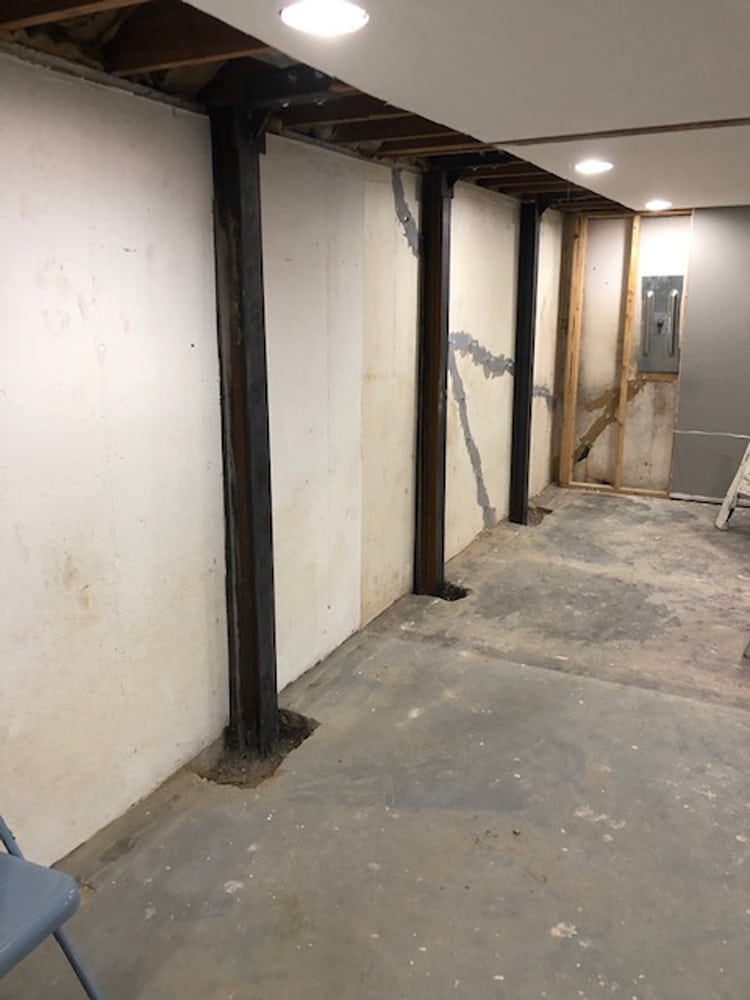
Stabilization means stopping additional inward movement. If a basement wall has been pushed inward by lateral soil pressure, continued movement can create more cracking, displacement, and stress on the framing above. A stabilization repair is intended to give that wall the support it needs so the condition does not continue progressing.
Straightening goes farther. The goal is to move some or all of the wall closer to its original position, either during the repair or gradually when the selected system allows adjustment. That may sound like the obvious better outcome, but a wall that has been out of position for years has already changed the way other parts of the house are sitting around it.
Floor framing, drywall, plumbing, windows, masonry, and interior finishes may all have adjusted to the wall’s current position. Moving the foundation wall can transfer stress into those components, so more movement is not automatically better.
For us, stabilization comes first. Once we know the wall can be supported safely, we can decide whether some amount of correction makes sense or whether leaving the wall in its current position is the better structural choice.
The Repair System Changes What Kind of Correction Is Possible
Different bowed-wall systems are designed to accomplish different things. Carbon fiber reinforcement and steel supports are generally used when the primary objective is to reinforce or stabilize the wall from inside the basement. They can be effective ways to control movement without requiring the wall to be pushed back into place.
Wall anchors and helical tiebacks work differently. These systems provide support by tying the wall back to more stable conditions outside the foundation, and in qualifying situations they may allow some controlled adjustment of the wall. Exterior access, soil conditions, utilities, wall construction, and the amount of existing movement all affect whether that is practical.
A simple comparison looks like this:
| Repair Approach | Primary Goal | What Homeowners Should Understand |
|---|---|---|
| Carbon fiber reinforcement | Stabilization | Low-profile reinforcement. Straightening is not usually the primary objective. |
| Steel supports | Stabilization and reinforcement | Interior bracing can support the wall without requiring exterior anchors. |
| Wall anchors | Stabilization with possible adjustment | Exterior access and wall condition affect whether correction is appropriate. |
| Helical tiebacks | High-capacity stabilization with possible adjustment | Soil, access, wall condition, and repair design determine the realistic goal. |
We do not use a universal measurement that automatically assigns one system to every wall. The amount of bowing matters, but so do wall material, crack pattern, how the wall has moved, and what is happening outside the foundation.
Why We Do Not Try to Force Every Bowed Wall Back to Plumb
A basement wall is part of a larger structure, not an isolated slab of concrete or block. Once a wall has moved, the framing above it and the finishes around it may have moved too. Aggressively forcing a damaged wall back can create new cracking or stress in areas that were not causing trouble before.
The wall itself may also limit how much movement it can safely tolerate. A poured concrete wall with one pattern of deflection is different from a concrete block wall with horizontal cracking, mortar-joint movement, or displacement near the top or bottom. We want to understand how the wall is failing before deciding that straightening is a reasonable objective.
Exterior conditions matter just as much. Saturated soil, poor grading, short downspouts, and repeated wetting around the foundation can increase pressure against a basement wall. St. Louis soils can also change significantly as moisture conditions shift through wet and dry seasons, but we do not assume soil is the cause of every bowed wall we inspect.
That is why we also look at whether water is contributing to the foundation movement. Fixing drainage does not automatically move a bowed wall back into place, but ignoring a water problem can leave one of the forces acting on the wall unresolved.
What We Measure Before Deciding on the Repair Goal
The amount of visible bowing is only one part of the inspection. We want to know where the movement is concentrated, whether the top or bottom of the wall has shifted, what kind of cracks are present, and whether the wall appears to be bending, rotating, or sliding.
We also look at the wall material, previous repairs, exterior grade, drainage, nearby utilities, and how much access is available outside. Those conditions can affect which repair systems are practical and whether controlled movement of the wall should even be considered.
Horizontal cracks usually get our attention because they can indicate pressure acting across a larger portion of the wall. Stair-step cracking in block or masonry can tell a different story, and a crack that has reopened after a previous repair tells us the wall may still be moving. Our foundation wall crack repair process starts with the same principle: the crack should be interpreted based on its cause rather than patched simply because it is visible.
The history is useful too. We ask whether the wall has changed recently, whether the cracks are widening, whether water problems have become worse, and whether previous repairs were made. A wall that has remained unchanged for years can be a different repair problem from one that is visibly progressing.
Can a Wall Be Stable Even If It Is Still Bowed?
Yes. A repaired wall does not have to be perfectly plumb for the repair to be successful.
If the structure has been properly stabilized and additional movement has been controlled, leaving some existing deflection may be safer and more practical than trying to force the wall completely back to its original position. Cosmetic cracks or an uneven appearance may remain even though the structural concern has been addressed.
That is an important expectation to establish before work begins. Structural repair and cosmetic restoration are not the same thing. A homeowner should understand whether the proposed system is intended to hold the wall where it is, allow some adjustment, or make a more substantial correction.
We also explain when drainage or waterproofing should be addressed alongside the structural work. Movement-related cracks can allow water into the basement, while drainage problems can contribute pressure outside the wall. Perma Jack evaluates both structural movement and related water intrusion, but one repair should not be assumed to solve the other automatically.
What Should You Do If Your Basement Wall Is Bowing?
If you see a horizontal crack, visible inward movement, separation near the top of the wall, or an old wall repair that appears to be moving again, the next step should be to have the wall measured before deciding what repair system you want.
When we inspect a bowed basement wall, we look at the movement, construction, cracks, drainage, exterior pressure, access, and history of the problem. From there, we can explain whether the wall mainly needs stabilization or whether some amount of controlled straightening may be appropriate.
The important question is not simply, “Can this wall be made straight again?” It is what repair gives this wall the safest and most reliable structural outcome from this point forward?
If you are seeing a bowed or leaning basement wall in the St. Louis area, we can evaluate the wall and explain what we would realistically expect from the available repair options before a system is selected.